
What Is Cash Flow? The Equation Behind Every Budget
One line of math, pictured as a bathtub, is the foundation for everything else in personal finance.
By Evan Sanning
Published Updated 6 min read
In this article11 sections
What is cash flow?
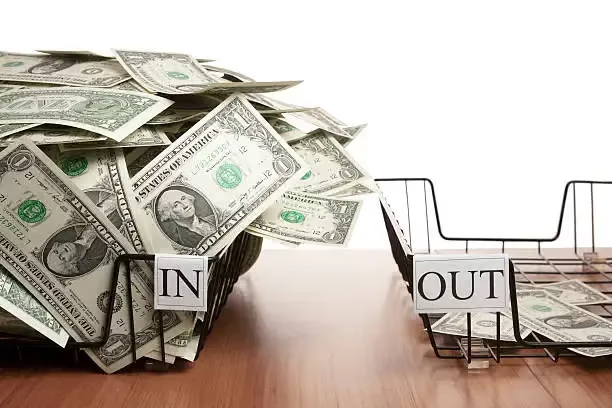
Cash flow is the money that comes in minus the money that goes out. If more comes in than goes out, you have positive cash flow, and that leftover is what you can save, invest, or use to pay down debt. If more goes out than comes in, you have negative cash flow, and the gap gets covered by savings or debt.
Here's the whole equation:
Income − Expenses = Cash Flow
It's the simplest math in personal finance, and it's the foundation for everything else: budgeting, emergency funds, investing, retirement. In my 20s, it was the one number I tracked every month: what came in and what went out. It's still the first number I look at whenever I'm planning our family's money.
Doesn't a bigger paycheck fix it?
Not on its own. Cash flow is about the gap between the two numbers, not the size of either one. Someone earning $150,000 who spends $155,000 is falling behind; someone earning $45,000 who spends $40,000 is getting ahead every month. A raise only helps if spending doesn't rise to swallow it.
Picture a bathtub
Think of your money as water in a bathtub.
- The faucet is your income: your paycheck after taxes, plus any side income.
- The drain is your expenses: rent or mortgage, groceries, car payment, subscriptions, that coffee.
- The water level is what you have. Your cash flow is whether that level is rising or falling each month.
If the faucet pours in faster than the drain empties, the tub fills up. That's positive cash flow. If the drain runs faster than the faucet, the level drops. That's negative cash flow.
A round-number example
Say the faucet brings in $4,000 a month after taxes, and the drain lets out $3,500 a month:
| Monthly | |
|---|---|
| Income (faucet) | $4,000 |
| Expenses (drain) | −$3,500 |
| Cash flow (water level change) | +$500 |
The tub rises by $500 every month, or $6,000 a year. That $500 is what builds an emergency fund, a down payment, or a college fund for your kid.
Now flip it. If expenses creep up to $4,300, cash flow is −$300 a month. The tub is draining $3,600 a year.
The drain you don't see every month
That $500 looks solid, but some drains only open a few times a year: car insurance billed every six months, holiday gifts, a car repair, a yearly subscription. They're easy to leave out of "a normal month."
Say those irregular costs add up to $3,000 a year. Spread across 12 months, that's $250 a month of drain you didn't count:
| Looks like | Actually | |
|---|---|---|
| Income | $4,000 | $4,000 |
| Monthly bills | −$3,500 | −$3,500 |
| Irregular costs (÷ 12) | not counted | −$250 |
| Cash flow | +$500 | +$250 |
Same faucet, same bills, but the real cash flow is half what it looked like: $3,000 a year, not $6,000. The fix is to count those costs as part of the drain and set a little aside for them each month.
How do you spend more than you make?
It sounds impossible to pour out more water than comes in, but it's easy when something hides the gap. The usual culprits:
- Credit cards that you don't pay off in full each month.
- Payday loans and "buy now, pay later" plans.
- Dipping into savings without noticing.
These feel like extra water in the tub, but they're borrowed water, and it has to be paid back with interest. Credit card interest is expensive: in the second quarter of 2026, the average rate on credit card accounts that were charged interest was 22.15%, according to the Federal Reserve's G.19 consumer credit report (opens in a new tab). Borrowed water makes the drain bigger next month.
What does cash flow look like for real households?
The real numbers work the same way as the round ones, just bigger. According to the Bureau of Labor Statistics' Consumer Expenditure Survey for 2025 (opens in a new tab), released in October 2026, the average U.S. household:
- Had $110,847 of income before taxes
- Spent $81,905 over the year
Most of that spending went down three drains:
| Expense | 2025 average | Share of spending |
|---|---|---|
| Housing | $27,790 | 33.9% |
| Transportation | $13,492 | 16.5% |
| Food | $10,633 | 13.0% |
Together that's almost two-thirds of all spending, which is why the biggest changes to the drain usually come from these three, not from the coffee.
Keep in mind that the income figure is before taxes, and the spending figure doesn't include income taxes, so the gap between them isn't all savings. A better measure of what's left over is the personal saving rate: in September 2026, Americans saved 3.8% of their after-tax income, according to the Bureau of Economic Analysis (opens in a new tab). That's under $4 of every $100 that came through the faucet. On average, the tub is barely rising. Both agencies post newer figures on those pages as they come out.
How do you find your own cash flow?
You don't need an app, just your statements and about half an hour:
- What came in last month: your take-home pay (what lands in your bank account, not your salary), plus any side income.
- What went out: everything on your bank and credit card statements. Count card purchases when you make them, not when you pay the bill, so borrowed water doesn't hide.
- The irregular costs: last year's big non-monthly ones, divided by 12.
Income minus the other two is your monthly cash flow. Most people find at least one drain they didn't know was that big.
How do you improve your cash flow?
Looking at the equation, there are only two levers:
Open the faucet (increase income):
- Ask for a raise, or look at what your skills are worth elsewhere. (And don't worry about a raise pushing you into a higher tax bracket. It always leaves you with more money.)
- Pick up a side gig or freelance work.
- Sell things you don't use anymore.
Plug the drain (reduce expenses):
- Start with the big three: housing, transportation, and food. A cheaper car or a roommate moves the level more than any number of skipped coffees.
- Cancel subscriptions you've forgotten about.
- Call your insurance, phone, and internet providers and ask for a better rate.
- Pay off high-interest debt, which shrinks the drain for good.
Small changes on either side add up. Cutting $100 a month is $1,200 a year more in the tub.
Why cash flow is the foundation
Every money goal is really a cash flow goal. An emergency fund, a car in a few years, a house, your child's college, retirement: each one needs the tub to be rising, and rising on purpose.
Knowing your number is the first half. The second is making a plan for it: a budget, deciding ahead of time how much goes to each drain and how much stays in the tub. Most people roll their eyes at the word, but making one, and sticking to it, is the single best way to get your expenses under control.
This is educational, not financial advice. If the numbers aren't working and you're not sure where to start, a nonprofit credit counselor or a financial planner can help.
What to take with you
- Cash flow = income − expenses. If the number is positive, your tub is filling. If it's negative, it's draining, even if a credit card hides it for a while.
- Find your number. Add up last month's take-home pay and last month's spending, plus your irregular yearly costs divided by 12. The difference is your monthly cash flow.
- Pick one lever. Choose one way to open the faucet or plug the drain this month, like canceling one subscription or calling one provider.
- Give the extra a job. Decide where your positive cash flow goes (an emergency fund first, then goals like retirement) so it doesn't quietly drain away.
- Talk about it. If you share finances with a partner, look at the tub together. It's a lot less awkward when it's just one number.
Want to see how taxes shape the water coming out of your faucet? Read how tax brackets actually work, or try the calculators.
About the author
Evan Sanning
I started We Learn Finance to explain money in plain language. I've been investing since my first real paycheck, and today I'm saving for retirement and my daughter's college in a 529 plan. I'm not a licensed financial advisor, so everything here is for education: check big decisions with a professional.
More about me and the site